How to Self-Exclude From Gambling: US, Canada, Australia and Ireland
23 October 2026 · 8 min read · Back to the blog
Updated: 23 October 2026
Key points
- Self-exclusion means asking to be blocked from gambling companies. It's free almost everywhere.
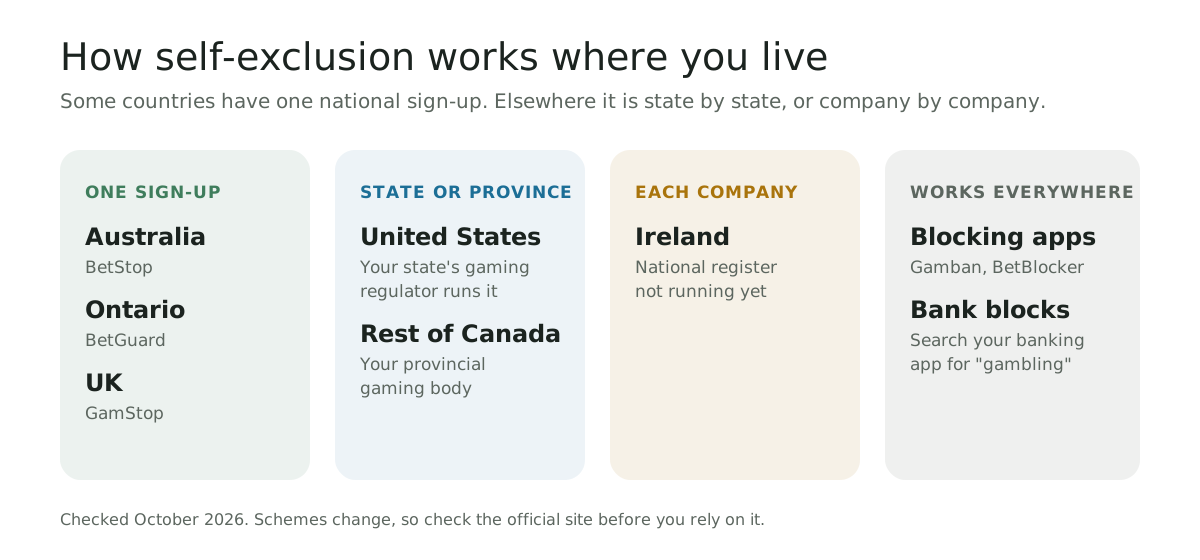
- Some places have one national sign-up, like BetStop in Australia and BetGuard in Ontario. In the US, it's state by state.
- Wherever you live, a blocking app and a bank gambling block add protection that self-exclusion can't.
Banning yourself from gambling is called self-exclusion. When you've decided you need a break, the hardest part is making that decision stick on a bad night. Self-exclusion does that for you. You sign up once, and gambling companies have to close your accounts and turn you away. How you do it depends on where you live.
United States
There's no national list. Each state that allows gambling runs its own program, usually through its gaming regulator. Once you're on it, licensed sportsbooks and casinos in that state have to keep you out.
- How to find yours: check your state's gaming regulator website. If you're not sure which body that is, search "[your state] gambling self-exclusion" and choose the official state site (it usually ends in .gov).
- How you sign up varies. Some states, like New Jersey and Pennsylvania, let you apply online. Others, like New York, ask for a form sent by post. Some states have no statewide list, so you ask each casino or sportsbook directly.
- How long: usually 1 year, 5 years or lifetime, depending on the state. You normally can't end it early.
- Free help with the forms: the National Voluntary Self-Exclusion Program (nvsep.com) helps you sign up in several states at once, including free online notarising where a state requires it.
The 10 biggest US betting states
| State | How you sign up | Official page |
|---|---|---|
| New York | Form by post (notarised) or in person. Free e-notary from the NY Council on Problem Gambling. 1, 3 or 5 years, or lifetime. | New York official page |
| New Jersey | Online for internet gaming and sports betting (1 or 5 years). Video call or in person for casinos or lifetime. Hotline 1-833-788-4343. | New Jersey official page |
| Pennsylvania | Online, through the state's self-exclusion portal. Covers casinos, online gambling and fantasy contests. | Pennsylvania official page |
| Illinois | In person only, at enrolment sites around the state. Covers casinos and sports betting. | Illinois official page |
| Michigan | Application form for the Responsible Gaming Database, which covers online gambling and sports betting. | Michigan official page |
| Ohio | Online, through Time Out Ohio. 1 or 5 years, or lifetime. Covers casinos and sports betting. | Ohio official page |
| Arizona | Notarised form by post, with remote notarising available. Sports betting has its own form. | Arizona official page |
| Massachusetts | By phone, live chat, video call or in person. 1, 3 or 5 years, or lifetime. | Massachusetts official page |
| Virginia | Online for 2 or 5 years. In person for lifetime. | Virginia official page |
| Maryland | In person, at the state's Baltimore office or any Maryland casino. 2 years minimum, or lifetime. | Maryland official page |
All links checked 23 October 2026. States change their rules, so follow the official page if anything differs.
Canada
- Ontario: BetGuard (betguard.ca) blocks you from every licensed online gambling site in Ontario in one go. It launched in May 2026, takes under 10 minutes, and you need to be 19 or over with ID and a phone. You choose 6 months, 1 year, 5 years or your own length.
- Other provinces: self-exclusion is run by your provincial gaming or lottery body. Search "[your province] self-exclusion" to find it.
Australia
BetStop (betstop.gov.au) is the national self-exclusion register. One free sign-up blocks you from every licensed online betting company in Australia, for anywhere from 3 months to a lifetime. Over 67,000 people have used it since it launched in 2023.
It covers online and phone betting, not pubs, clubs or casinos. For venues, ask your state's venue self-exclusion program.
Ireland
A national exclusion register is planned under the Gambling Regulation Act 2024, but it isn't running yet. For now, you self-exclude with each betting company separately, by phone, email, live chat or their website. That makes the tools below especially important in Ireland.
Elsewhere in Europe
Many countries have a national register. Examples include OASIS in Germany, Cruks in the Netherlands, Spelpaus in Sweden and RGIAJ in Spain. Search the name, or "[your country] gambling self-exclusion", to find the official page.
After you self-exclude
Self-exclusion closes the door to gambling accounts, but it doesn't switch off the urge. The first few weeks can feel hard, and that's normal. Many people also:
- Turn on a bank gambling block, so the money is protected too.
- Install blocking software for sites the scheme doesn't cover.
- Tell one person they trust what they've done.
- Plan what to do when an urge hits, like a short walk, a call, or a check-in.
What works in every country
- Blocking apps: Gamban and BetBlocker block gambling sites and apps on your devices, including offshore and crypto casinos that self-exclusion schemes don't reach.
- A bank gambling block: search your banking app for "gambling". Here's how bank blocks work.
- Telling one person: self-exclusion works better when someone you trust knows you've done it.
Common questions
Does self-exclusion stop all gambling?
No. It covers licensed gambling companies in the area the scheme runs. Offshore sites, and often venues and lotteries, aren't included. That's why blocking apps and bank blocks help.
Can I cancel a self-exclusion early?
Usually not. Most schemes hold until the minimum period you chose has ended. That's deliberate, because it protects you on the days you'd want it gone. Check your scheme's rules before you choose a length.
Does self-exclusion cover offshore or crypto casinos?
No. Schemes only cover companies licensed where you live. Blocking apps like Gamban and BetBlocker can block offshore and crypto sites on your devices.
What's the difference between self-exclusion and a gambling block?
Self-exclusion closes your gambling accounts and stops you opening new ones. A bank gambling block stops your card paying gambling companies. Using both closes two different doors.